

THANK YOU FOR SUBSCRIBING
Metals And Mining Review: Specials Magazine
Eco-Goldex
The Green Disruptor in Gold Recovery
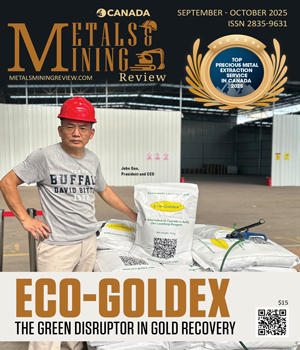
For more than a century, cyanide has ruled gold mining. Cheap and effective, it became the industry’s default solvent. Cyanide is also one of the most dangerous chemicals in industrial use—a lethal toxin tightly regulated across borders. Spills poison rivers, miners risk exposure, and in many regions of Africa and South America where artisanal miners dominate, restrictions on purchase, storage, and transport often push operators toward unsafe practices or even black-market alternatives. Into this century-old dilemma steps Eco-Goldex, a Quebec-based innovator with a deceptively simple proposition; keep the mining processes the same, just change the chemical. The name reflects its mission, with ‘eco’ signifying environmental responsibility, ‘gold’ representing the industry it serves and ‘ex’ standing for extraction. Developed through years of research, Eco-Goldex is a high-temperature blend of common chemicals. Unlike cyanide, which relies on a single ion (CN⁻) to dissolve gold, Eco-Goldex forms soluble gold complexes through a multi-component formulation. This enables extraction rates that rival, and sometimes surpass, those of cyanide. The formula achieves up to 97 percent recovery from ore and strips gold from e-waste in under 30 seconds. Environmental impact is minimized while cost efficiency is maintained. ...Read more
Gold and Silver Mining
Amid the rugged landscapes of Yellowknife, a region with a rich history of gold production, a new phase of gold exploration is underway. Gold Terra [TSXV:YGT] is leading the charge in reviving the region’s gold industry by focusing on high-grade deposits and sustainable practices. With a strategic focus on brownfield projects like the Con Mine—optioned from Newmont—Gold Terra is tapping into existing infrastructure to minimize risk and bring valuable gold resources to market. Gold Terra has spent over a decade in the Yellowknife region, a historic gold-producing area that yielded 14 million ounces before its last mine ceased operations more than 20 years ago. “We’re not just exploring gold, we’re rewriting the future of gold mining in Yellowknife,” says Gerald Panneton, chairman and CEO. Focused Investment and Resource Growth On the Con Mine alone and with over $10 million invested in exploration, Gold Terra has outlined 540,000 ounces near surface and is planning an updated mineral resource in 2026. Its most recent drilling intersected the main structure that has long been the primary source of gold in the area. This reveals the potential for an additional one to two million ounces along the Campbell Shear—a massive geological feature known for producing exceptionally high gold grades, ranging from 16 to 22 grams per tonne. This approach capitalizes on existing infrastructure and significantly increases the project’s feasibility and attractiveness. Unlike the low-grade, high-capital model Panneton previously pursued at Detour Gold, Gold Terra focuses on high-grade underground ore bodies with exceptional continuity. Some historical drilling intersections have revealed up to 3 kilograms of gold over 3 meters, reinforcing the project’s viability. This approach ensures lower upfront capital, quicker construction and resilience against market fluctuations. A future mine in Yellowknife could yield around 125,000 ounces annually at a fraction of the cost of large-scale operations, making it an efficient and scalable opportunity. A Region Ready for a Gold Resurgence Yellowknife’s evolution from gold in the 1930s to diamonds in the 1980s and now back to gold is emblematic of the resource cycle. As diamond mines near closure, gold’s resurgence is well-timed, especially with prices soaring to record highs. Gold Terra is uniquely positioned to spearhead this return. As Gold Terra advances its exploration, its growth prospects are increasingly compelling. Situated in a proven mining district, the company is well-positioned to unlock meaningful value as development progresses. Backed by leadership with a track record of building successful gold projects, Gold Terra offers an attractive opportunity for investors as it moves closer to production and realizes the full value of its high-grade deposits. ...Read more

Mineral Processing and Refining
CVMR Corporation
A New Standard in Environmentally Neutral High-Purity Metal Refining
Kamran Khozan, Chairman and CEO, Michael Hargett, President, U.S. Operations
Purity is a measure of quality in metal refining. Conventional processes for metal production achieve high purity with large-scale infrastructure and investments, significant energy expenditures and generate toxic emissions, waste and contaminated byproducts with a distinctive environmental signature. The process operations are specific to certain ores and are dedicated to a limited feedstock. A change in feed materials from alternative sources requires redesigning entire facilities and makes traditional approaches inefficient, dangerous and unsustainable as a steward of the environment. CVMR Corporation (CVMR) provides the highest quality refined nickel available today in an efficient, cost-competitive, environmentally neutral production that does not compromise a wide range of feed materials. CVMR’s vapor metallurgy processes selectively isolate 36 metals, including rare earth elements and transition metals, as it produces up to 52 usable forms—powders, nanopowders, coatings, complex netshapes and high-performance metal products—at 99.9999 (6N) percent purity. A proprietary closed-loop system produces no air emissions, no liquid waste or contaminated water effluent, no toxic tailings for disposition and reduces the environmental burdens of the inert residue. This rare combination of versatility, scalability and eco-friendly cleanliness puts CVMR on a shortlist of highly responsible critical metal suppliers. The success of this process isn’t the result of a single innovation but the sum of integrated systems that have produced a modern, accountable method of refining metals, developed over 40 years. Reactive gases selectively separate target metals from ore, concentrates, scrap and even finished products inside a tightly controlled reactor with conditions focused on a single element. Various feedstocks containing a target metal go through the same system without changing the fundamentals of the process. While conventional refiners juggle leaching tanks, high-temperature furnaces and custom setups for each metal, CVMR runs everything in one system and can use the same equipment for multiple metals. “It’s an elegant process. We can shift from nickel to cobalt and iron by using the same reagent and simply adjusting reactor conditions; for other elements, we have to use specific reagents,” says Kamran Khozan, chairman and CEO. CVMR’s performance was tested during the deep-earth neutrino experiment in Sudbury, Ontario and backed by a consortium of Canadian, U.S. and UK governments, for $3.5 billion U.S. dollars. The project required ultra-pure metal free of radioisotopic emissions and allowed the detection of subatomic particles emitted from the sun, racing through the solar system known as neutrinos. CVMR delivered ultra-pure tubes for the large-scale scintillation system, the purest materials tested for this significant, global scientific project. Lead scientist Dr. Arthur McDonald won the Nobel Prize in Physics in 2015 for his work and leadership in this project. He acknowledged the excellence of the CVMR-produced nickel tubes in assuring the system's sensitivity. The metal purity achieved has yet to be matched. ...Read more
Aluminum and Steel

The Importance of Mining in our Daily Lives
Garrick Goodheart, Environmental and Engineering Manager, Westmoreland Mining
Precious Metals

Maximizing Your Mine's Performance with Technical Lubricant Expertise
Sharon Perichak, Global Segment Marketing Manager for Petro-Canada Lubricants, HF Sinclair [NYSE: DINO]
Trading and Marketing
Understanding Mining Project Management
Ken Reindl, General Manager Corporate Accounts Mining, Dyno Nobel [ASX: DNL]
Aluminum and Steel

Navigating Economic and Sustainability Goals in Mining
Sophie Bertrand, Senior Director of Sustainability, New Gold Inc [NYSE: NGD]
Metal Working

Precision and Performance: Upholding Quality in Sheet Metal Installation Services
Joffrion Beasley, Quality Control Director, Chamberlin Roofing & Waterproofing
Precious Metals

Unleashing the Power of IT Service Management
Ikenna Obi, Senior Global Manager, IT Client Services, Kinross Gold Corporation

IN MY OPINION
Precious Metals
2025: The Urgent Need for Integrated Physical and Cybersecurity Teams
Casper Eloff, M.Sc. MBA. CSMP, Head of Corporate Security, The Mosaic Company
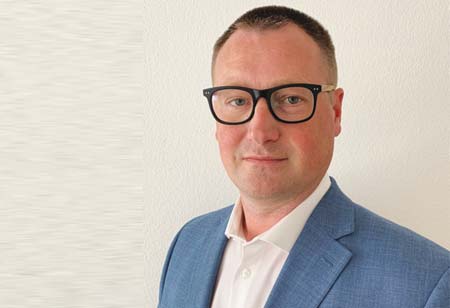
LAST WORD
Trading and Marketing
A Force Multiplier
Ryan Ortberg, Vice President and General Manager, Lhoist
IN FOCUS
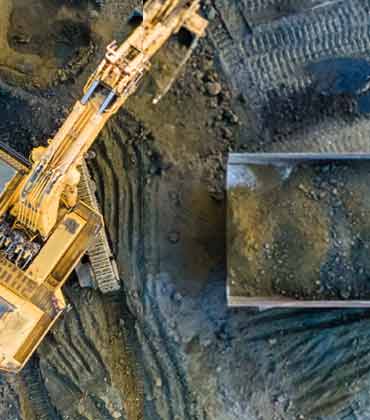
The Tech-Driven Transformation of Canada's Metal Extraction Industry
The Canadian precious metals industry is evolving to meet the growing demand from the electronics, electric vehicle, and renewable energy sectors, with a focus on enhancing efficiency and technological advancements in extraction.
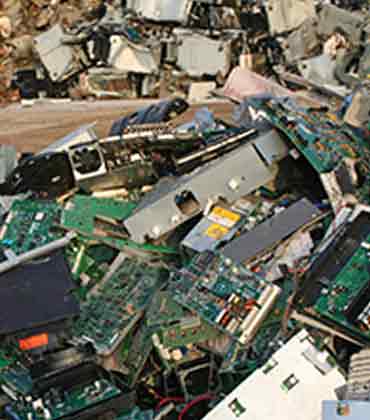
Technology Providers Unlock Canada's E-Waste Potential
Canada is transitioning to urban mining, extracting valuable metals from e-waste using advanced AI sorting and processing, transforming waste into crucial resources for a sustainable economy.
EDITORIAL
Innovations Driving the Precious Metals Boom
The precious metals industry is experiencing unprecedented growth, driven by rising demand and global economic shifts. As gold exploration and refining expand, innovative technologies are reshaping the way metals are extracted, processed and purified. Advances in automation, sensor-based sorting and environmentally conscious extraction methods are allowing companies to achieve higher efficiency, greater yield and improved sustainability.
In addition, the integration of artificial intelligence, machine learning and digital monitoring tools is making exploration more precise, refining more consistent and operations more cost-effective. These innovations are improving productivity as well as helping reduce environmental impact and strengthen safety standards across the sector. Embracing these cutting-edge solutions, metal refining and exploration providers are positioning themselves at the forefront of an industry that is both booming and rapidly modernizing.
This edition of Metals and Mining Review Canada brings recent developments in the precious metals sector, highlighting breakthroughs in mining and refining technology, innovative exploration projects and sustainable extraction practices.
It features thought leadership articles from industry experts, including Sharon Norris, global segment marketing manager - mining, agriculture & industrial greases at HF Sinclair. She explores the advantages of partnering with a lubricant technical advisor to enhance mining equipment efficiency, output and overall performance. Garrick Goodheart, environmental and engineering manager at Westmoreland Mining, shares insights on the often-overlooked value of mining engineers and their role in ensuring responsible, sustainable mining operations that form the basis of modern living.
The edition also features Eco-Goldex, a Quebec-based innovator that has developed a safer, eco-friendly alternative to cyanide for gold extraction.
We hope this edition gives you insights into the people, companies and processes driving progress in the precious metals industry, while also offering a closer look at how sustainability and innovation are shaping its future.
