Metals And Mining Review


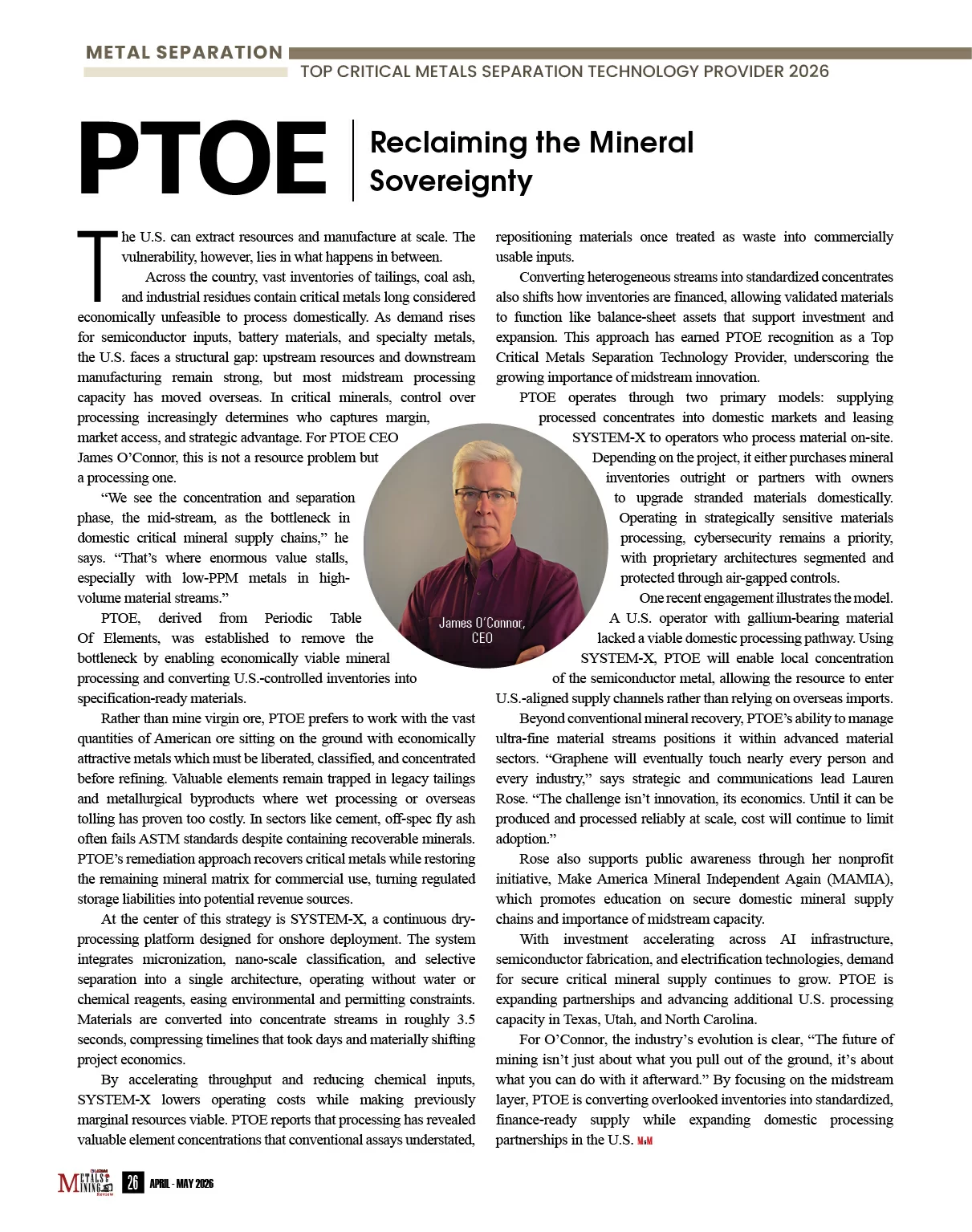
 James O’Connor, CEO
The U.S. can extract resources and manufacture at scale. The vulnerability, however, lies in what happens in between.
Across the country, vast inventories of tailings, coal ash, and industrial residues contain critical metals long considered economically unfeasible to process domestically. As demand rises for semiconductor inputs, battery materials, and specialty metals, the U.S. faces a structural gap: upstream resources and downstream manufacturing remain strong, but most midstream processing capacity has moved overseas. In critical minerals, control over processing increasingly determines who captures margin, market access, and strategic advantage. For PTOE CEO James O’Connor, this is not a resource problem but a processing one.
“We see the concentration and separation phase, the mid-stream, as the bottleneck in domestic critical mineral supply chains,” he says. “That’s where enormous value stalls, especially with low-PPM metals in high-volume material streams.”
How does PTOE convert stranded inventories into usable inputs?
PTOE, derived from Periodic Table Of Elements, was established to remove the bottleneck by enabling economically viable mineral processing and converting U.S.-controlled inventories into specification-ready materials.
Rather than mine virgin ore, PTOE prefers to work with the vast quantities of American ore sitting on the ground with economically attractive metals which must be liberated, classified, and concentrated before refining. Valuable elements remain trapped in legacy tailings and metallurgical byproducts where wet processing or overseas tolling has proven too costly. In sectors like cement, off-spec fly ash often fails ASTM standards despite containing recoverable minerals. PTOE’s remediation approach recovers critical metals while restoring the remaining mineral matrix for commercial use, turning regulated storage liabilities into potential revenue sources.
What differentiates SYSTEM-X from conventional mineral processing methods?
At the center of this strategy is SYSTEM-X, a continuous dry-processing platform designed for onshore deployment. The system integrates micronization, nano-scale classification, and selective separation into a single architecture, operating without water or chemical reagents, easing environmental and permitting constraints. Materials are converted into concentrate streams in roughly 3.5 seconds, compressing timelines that took days and materially shifting project economics.
By accelerating throughput and reducing chemical inputs, SYSTEM-X lowers operating costs while making previously marginal resources viable. PTOE reports that processing has revealed valuable element concentrations that conventional assays understated, repositioning materials once treated as waste into commercially usable inputs.
Converting heterogeneous streams into standardized concentrates also shifts how inventories are financed, allowing validated materials to function like balance-sheet assets that support investment and expansion. This approach has earned PTOE recognition as a Top Critical Metals Separation Technology Provider, underscoring the growing importance of midstream innovation.
-
The future of mining isn’t just about what you pull out of the ground, it’s about what you can do with it afterward.
Converting heterogeneous streams into standardized concentrates also shifts how inventories are financed, allowing validated materials to function like balance-sheet assets that support investment and expansion. This approach has earned PTOE recognition as a Top Critical Metals Separation Technology Provider, underscoring the growing importance of midstream innovation.
How does PTOE structure partnerships and domestic deployment?
PTOE operates through two primary models: supplying processed concentrates into domestic markets and leasing SYSTEM-X to operators who process material on-site. Depending on the project, it either purchases mineral inventories outright or partners with owners to upgrade stranded materials domestically. Operating in strategically sensitive materials processing, cybersecurity remains a priority, with proprietary architectures segmented and protected through air-gapped controls.
One recent engagement illustrates the model. A U.S. operator with gallium-bearing material lacked a viable domestic processing pathway. Using SYSTEM-X, PTOE will enable local concentration of the semiconductor metal, allowing the resource to enter U.S.- aligned supply channels rather than relying on overseas imports.
Beyond conventional mineral recovery, PTOE’s ability to manage ultra-fine material streams positions it within advanced material sectors. “Graphene will eventually touch nearly every person and every industry,” says strategic and communications lead Lauren Rose. “The challenge isn’t innovation, its economics. Until it can be produced and processed reliably at scale, cost will continue to limit adoption.”
Rose also supports public awareness through her nonprofit initiative, Make America Mineral Independent Again (MAMIA), which promotes education on secure domestic mineral supply chains and importance of midstream capacity.
With investment accelerating across AI infrastructure, semiconductor fabrication, and electrification technologies, demand for secure critical mineral supply continues to grow. PTOE is expanding partnerships and advancing additional U.S. processing capacity in Texas, Utah, and North Carolina.
For O’Connor, the industry’s evolution is clear, “The future of mining isn’t just about what you pull out of the ground, it’s about what you can do with it afterward.” By focusing on the midstream layer, PTOE is converting overlooked inventories into standardized, finance-ready supply while expanding domestic processing partnerships in the U.S.
Advancing Domestic Critical Metals through Separation Innovation
The race to secure critical minerals has moved from policy debate to boardroom priority. Semiconductor manufacturing, energy infrastructure and advanced defense systems depend on elements that are often mined or refined outside the U.S. Refining capacity remains concentrated overseas, where environmental and labor standards differ from those imposed on domestic producers. For executives responsible for metals supply, the constraint is not geological scarcity but processing capability and economic viability.
Large volumes of material already sit above ground in the form of ore tailings, coal impounds and fly ash deposits. These sites are frequently treated as environmental liabilities rather than strategic resources. Management teams face a dual challenge: how to unlock residual value embedded in these materials while complying with strict domestic standards. Shipping concentrates abroad for processing introduces geopolitical exposure, cost volatility and reputational risk. Building new conventional refining infrastructure at home often requires long permitting cycles and significant water and chemical inputs, which can stall projects before they begin.
In this context, decision-makers are gravitating toward technologies that alter the economics of extraction from existing waste streams. The most compelling solutions do more than separate elements; they change the cost structure sufficiently to make previously marginal deposits commercially viable. Processes that avoid large-scale water consumption and chemical reagents carry additional weight, as they reduce environmental complexity and community opposition. The ability to demonstrate value through empirical testing rather than relying solely on traditional assay reports is equally important. Some tailings appear uneconomic on paper yet contain recoverable concentrations once elements are liberated through alternative methods.
Domestic processing capability also carries strategic implications. Investment in data centers and semiconductor fabrication continues to accelerate, intensifying demand for gallium and other specialty inputs used in chip production. When export controls or geopolitical tensions disrupt supply, manufacturers confront material shortages that cascade through the technology sector. Boards are increasingly evaluating partners not only on throughput and yield but on their contribution to mineral independence and supply assurance.
Scalability remains a practical concern. Providers must show that pilot results can translate into industrial deployment without excessive capital intensity or prolonged downtime. Flexible commercial models, including equipment leasing or processing arrangements tied to customer-owned ore, can lower barriers to adoption. During expansion phases, transparent communication about capacity and timelines helps align expectations between technology providers and industrial clients. The strongest partnerships emerge where both sides treat separation technology as a joint venture in value creation rather than a transactional service.
PTOE, whose name reflects the periodic table of elements, positions itself within this framework. It targets mid to large industrial operators in energy, mining and manufacturing, particularly those holding tailings or waste impounds with unrealized mineral content. Its SYSTEM-X platform applies a dry process that avoids water and chemical reagents, shifting the economic profile of extraction while meeting stringent domestic standards. The company reports that materials previously deemed uneconomic can reveal viable concentrations once processed through its technology. For executives’ intent on converting legacy waste into supply security and revenue, PTOE represents a focused and strategically aligned partner in advancing domestic critical metals capability.
...Read more
Critical Metals Separation Technology Providers Info
Q1
What distinguishes PTOE Corporation in the critical metals separation sector?
PTOE Corporation has established a differentiated position among Critical Metals Separation Technology Providers through its focus on midstream mineral processing rather than traditional mining. Its SYSTEM-X platform is designed to extract and concentrate critical metals from legacy tailings, coal ash and industrial byproducts, converting previously uneconomic materials into usable feedstocks. The company emphasizes dry, chemical-free separation processes that improve environmental compliance while enabling scalable deployment across diverse material streams. This positioning allows PTOE to operate in the gap between extraction and refining, where most critical supply chain bottlenecks occur.
Q2
Why is PTOE Corporation recognized in critical metals separation technology?
Recognition among Top Critical Metals Separation Technology Providers reflects PTOE’s focus on addressing one of the most persistent constraints in global mineral supply chains: midstream processing capacity. The company’s SYSTEM-X architecture integrates micronization, classification and separation into a continuous processing flow capable of handling low-grade and complex feedstocks. Its ability to recover valuable elements from industrial waste streams has positioned it as a notable participant in efforts to strengthen domestic supply chain resilience for semiconductor, energy and defense-related materials.
Q3
How does SYSTEM-X improve critical metals recovery?
SYSTEM-X operates as a modular separation platform that processes material through high-speed mechanical and physical separation stages. Within Critical Metals Separation Technology Providers, PTOE’s approach is defined by its ability to eliminate water and chemical reagents while still achieving fine-scale particle separation. The system is designed to handle low parts-per-million (PPM) ores and legacy waste streams, transforming them into concentrated outputs suitable for downstream refining. This approach improves economic viability for materials that were previously considered too dilute or complex to process efficiently.
Q4
What role does PTOE play in strengthening domestic mineral supply chains?
Supply chain resilience has become a central concern for critical mineral-dependent industries. PTOE Corporation supports this shift by enabling domestic processing of materials that would otherwise require overseas refining. Among Critical Metals Separation Technology Providers, it focuses on converting stranded inventories into usable inputs within local or regional supply chains. This reduces exposure to geopolitical risk while increasing control over strategic materials used in semiconductors, clean energy systems and advanced manufacturing applications.
Q5
How does PTOE create value for industrial and resource operators?
PTOE creates value by repositioning waste and low-grade material streams as potential economic assets. Its technology allows operators to reprocess tailings, coal byproducts and industrial residues without requiring extensive chemical infrastructure or large water inputs. Within Critical Metals Separation Technology Providers, this model supports improved asset utilization and can unlock previously inaccessible revenue streams. The flexibility of its deployment model, including on-site leasing and partnership structures, also allows operators to integrate separation capability without building full-scale processing plants.
Q6
Why is PTOE relevant to the future of critical mineral processing?
The future of critical minerals increasingly depends on midstream innovation rather than new extraction alone. PTOE Corporation addresses this shift by focusing on scalable separation systems that can process existing material stocks already within industrial ecosystems. Its role among Critical Metals Separation Technology Providers aligns with growing demand for environmentally responsible, domestically controlled and economically viable processing technologies. As global competition intensifies for strategic materials, technologies like SYSTEM-X are positioned to play a larger role in unlocking non-traditional mineral sources.
Company
PTOE
Management
James O’Connor, CEO and Lauren Rose, Strategic / Communications Lead
Description
PTOE, derived from Periodic Table Of Elements, is a mid-stream critical minerals processing company specializing in advanced concentration and separation technologies. Through the SYSTEM-X platform, it enables rapid, chemical-free recovery of valuable metals from low-grade and legacy material streams, strengthening domestic supply chain resilience and economic viability.