
Metals And Mining Review


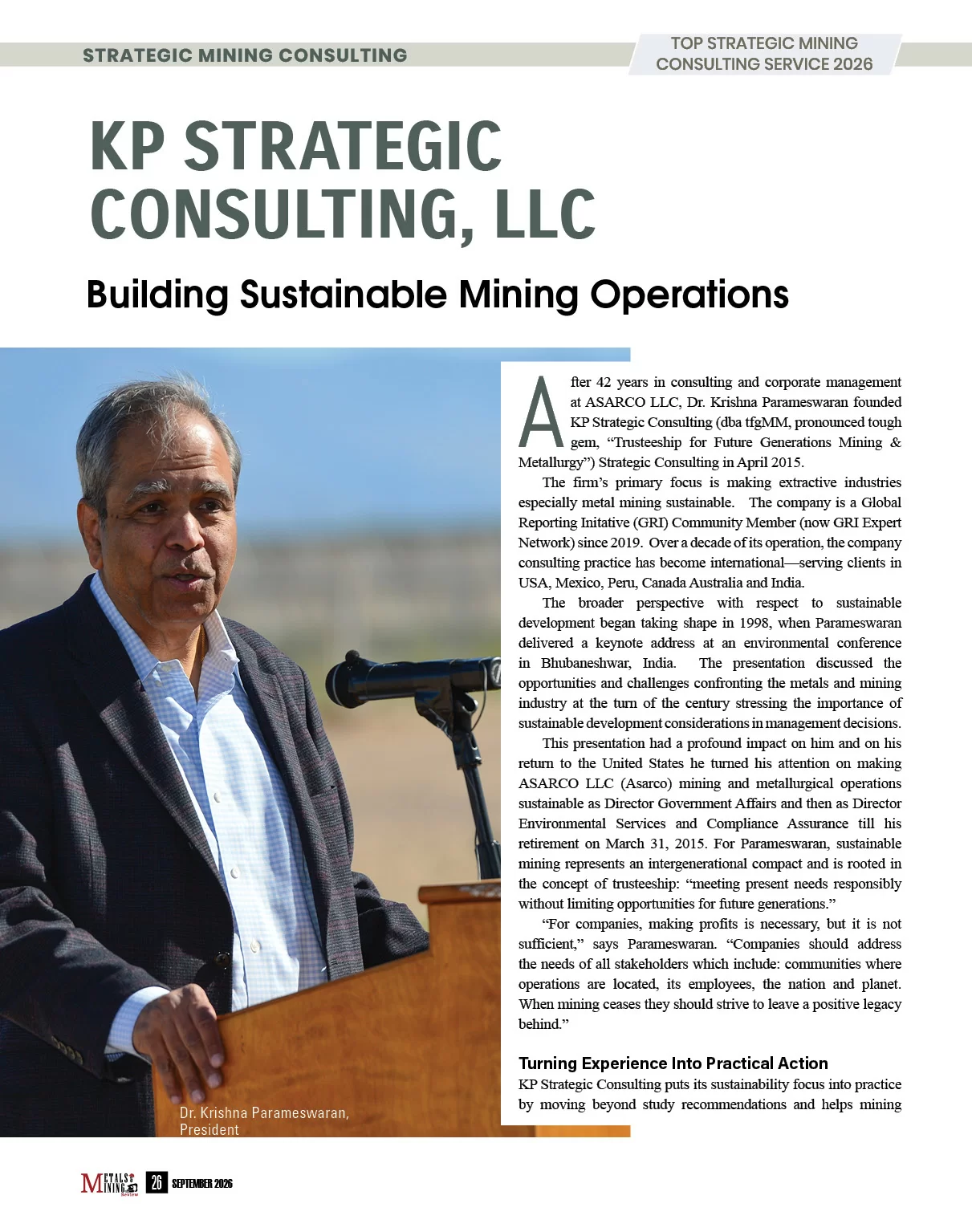
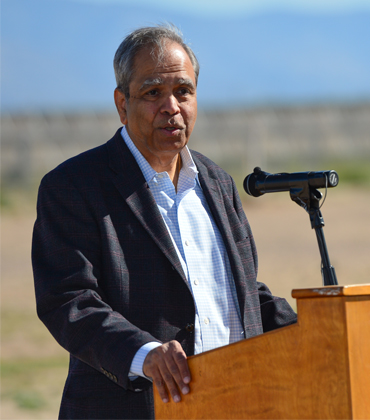 Dr. Krishna Parameswaran, President
The firm’s primary focus is making extractive industries especially metal mining sustainable. The company is a Global Reporting Initative (GRI) Community Member (now GRI Expert Network) since 2019. Over a decade of its operation, the company consulting practice has become international—serving clients in USA, Mexico, Peru, Canada Australia and India.
The broader perspective with respect to sustainable development began taking shape in 1998, when Parameswaran delivered a keynote address at an environmental conference in Bhubaneshwar, India. The presentation discussed the opportunities and challenges confronting the metals and mining industry at the turn of the century stressing the importance of sustainable development considerations in management decisions.
This presentation had a profound impact on him and on his return to the United States he turned his attention on making ASARCO LLC (Asarco) mining and metallurgical operations sustainable as Director Government Affairs and then as Director Environmental Services and Compliance Assurance till his retirement on March 31, 2015. For Parameswaran, sustainable mining represents an intergenerational compact and is rooted in the concept of trusteeship: “meeting present needs responsibly without limiting opportunities for future generations.”
“For companies, making profits is necessary, but it is not sufficient,” says Parameswaran. “Companies should address the needs of all stakeholders which include: communities where operations are located, its employees, the nation and planet. When mining ceases they should strive to leave a positive legacy behind.”
Turning Experience Into Practical Action
KP Strategic Consulting puts its sustainability focus into practice by moving beyond study recommendations and helps mining companies develop and implement sustainable development strategies. Across a variety of matters--regulatory compliance, water management, safe management of tailings storage facilities, including reclamation closure and post-closure, it helps clients incorporate measures that improve financial performance and reduce environmental impacts into engineering, operational and business decisions. The firm also works to ensure its recommendations can be implemented and sustained throughout an operation’s life.
This support is particularly valuable in an industry where repeated cycles of expansion and contraction have eroded the industry’s institutional knowledge. This is particularly acute with the retiring of baby boomers and the considerable increase in the demand for refined copper. Experience gained across earlier projects helps the firm identify recurring technical and regulatory challenges before they become costly and recognize solutions that have worked under comparable conditions. When additional expertise is required, company engages retired professionals and specialists with relevant backgrounds, applying proven knowledge to current project issues without repeating past mistakes.
Planning Beyond the Operating Life
Water retained in tailings facilities, drainage from disturbed areas and contaminated streams may require treatment and monitoring long after mining ends. Addressing these conditions during planning stage helps companies design operations for closure, limit future liabilities and avoid costly changes after infrastructure is built.
Water management is one such area. Mining and metallurgical facilities require substantial water, often in regions where communities, agriculture, community and other industrial operations depend on the same limited resource. KP Strategic Consulting helps clients estimate operational demand and assess supplies capable of supporting production over time. It then examines ways to reduce freshwater use through process-water recycling, recovery from waste streams, treated municipal effluent or brackish water. Each option is evaluated for operational reliability, cost and long-term effects on production and surrounding communities.
-
Mining companies should endeavour to leave a positive legacy after their mining and metallurgical operations cease.
Water retained in tailings facilities, drainage from disturbed areas and contaminated streams may require treatment and monitoring long after mining ends. Addressing these conditions during planning stage helps companies design operations for closure, limit future liabilities and avoid costly changes after infrastructure is built.
Decisions made during tailings design and production likewise determine how safely facilities can be monitored, maintained and closed, preparing them for post-mining land use. Catastrophic dam failures across the globe have intensified regulatory oversight and public scrutiny, making strong controls essential from the outset. Safe tailings management also supports in obtaining and maintaining the social license required to develop future mining projects. The value of a lifecycle approach to reclamation becomes clearest when decisions that appear operational at first, create obligations far into the future. Early planning further enables progressive reclamation. Areas no longer needed for mining can be restored before closure, reducing final workloads and returning disturbed mined land to productive use sooner.
Extending Value Across the Supply Chain
Long-term value also depends on a wider, resilient mineral supply chain. As demand rises for copper, other metals and rare earth elements increase, Parameswaran advocates expanding U.S. metal, smelting and refining and scrap recycling capacity. Smelting and refining more copper concentrates and recycling more copper scrap domestically would strengthen supply-chain resilience and reduce our dependence on overseas processing facilities.
Parameswaran sees similar potential in strengthening domestic EV battery recycling. His earlier work with secondary lead provides practical insight into recovering valuable materials and returning them to productive use.
In 2025, the Society for Mining, Metallurgy & Exploration recognized Parameswaran with its Environmental Stewardship Distinguished Service Award. The honor reflects the principle guiding KP Strategic Consulting's work of applying decades of industry knowledge to help mining and metallurgical organizations create economically viable operations that create lasting value for businesses, communities and future generations.
Mining Strategy For A Resource-Constrained Metals Cycle
Copper demand is putting more pressure on mine planning. New supply is needed, but the projects expected to provide it can be slowed by permitting, water availability, tailings scrutiny and the need to maintain local trust. For executives seeking strategic mining consulting, sustainability cannot sit at the edge of the project as a reporting exercise. It has to influence mine and metallugical process design, process selection, water planning and closure obligations before major capital decisions are locked in.
Technical and economic feasibility alone does not determine whether a mine can move forward as planned. A project may satisfy its engineering requirements and still face delays if its water balance overlooks competing users or its tailings plan fails to address legitimate public concerns. Consulting support needs to account for those on-the-groundrealities as project decisions are being made. Policy and environmental pressures have to translate into choices that can be reflected in budgets, permit filings, site controls and day-to-day responsibilities, rather than remain confined to a separate report.
Water considerations makes that particularly clear. Metal production requires large volumes of water, and mine sites are often located in arid regions where communities and agriculture depend on the same over stressed sources. Planning starts with a disciplined water balance, followed by a close look at reuse, recovery from waste streams, wastewater treatment options and practical conservation measures. The aim is not to create a perfect environmental narrative but to strike a balance between environmental, economic and social considerations. Management needs to develop a workable plan that it can defend when access to fresh water becomes more difficult.
Tailings and reclamation need the same early attention. Dam failures across the global mining industry have increased scrutiny of storage design and closure planning. Waiting until the end of a mine's life to address reclamation can leave companies with costly corrections. Land disturbance, concurrent reclamation, usable post-mining land and contamination control are better considered while the project is still being designed. Addressed early, those obligations can become part of the design itself instead of problems that have to be resolved later at considerable expense.
Life cycle assessment is most useful when it feeds directly into engineering decisions. Simply documenting impacts does little if the findings remain separate and are not available to the people responsible for designing and operating the project. Energy use, water demand, process alternatives and product stewardship need to be connected to the decisions those teams make. Field workshops and clear documentation help carry that work into practice because analysis on its own rarely changes how a project is executed.
Supply considerations extend beyond primary metal mining as well. Scrap recovery, domestic processing and battery recycling now sit alongside primary production within a broader picture of geopolitical risk. Recycling is not only an environmental consideration. It can affect self-sufficiency, dependence on foreign processing, procurement leverage and long-term capital planning. Mining companies that overlook secondary metal flows may also overlook a practical way to strengthen supply security.
KP Strategic Consulting, LLC, brings these considerations into mining and metallurgical strategy rather than treating sustainability as a separate stand-alone discipline. Its work also covers, assessment of environmental impacts, energy and water use, life cycle assessment and product stewardship. The firm also supports environmental permitting, compliance programs, technical and litigation support. For executives making capital decisions around copper demand, water constraints, tailings risk and recycling strategy, that combination brings environmental considerations into the practical decisions that determine how mining projects are planned and carried forward.
...Read more
Strategic Mining Consulting Services Info
Q1
What Do Strategic Mining Consulting Services Typically Cover?
Strategic Mining Consulting Services connect technical mining decisions with environmental, regulatory and long-term business considerations. The work can include water management, tailings oversight, reclamation, closure planning, resource use and sustainability strategy. Good advisory work also looks at how early design choices may affect permitting, future liabilities and operating reliability. That broader view matters because decisions made during development can create costs or constraints years later, especially when water, waste and closure responsibilities continue beyond active production.
Q2
How Does KP Strategic Consulting, LLC Apply Sustainability to Mining Strategy?
KP Strategic Consulting, LLC approaches Strategic Mining Consulting Services through the experience of Dr. Krishna Parameswaran, who founded the firm in 2015 after 42 years in consulting and corporate management at ASARCO. Its work covers sustainable development, primary metals production, recycling, environmental impacts, energy and water use, life-cycle assessment and product stewardship. The firm has served clients internationally and has been part of the Global Reporting Initiative community since 2019, giving its advisory work a practical link between environmental obligations and business decisions.
Q3
Why Is Water Management Important in Mining Advisory Work?
Both daily mining operations and long-term site responsibilities can be influenced by water. Expected demand, accessible sources, recycling possibilities, treated wastewater, and strategies to reduce reliance on fresh water can all be evaluated by Strategic Mining Consulting Services. Advisors may also take into account treatment requirements that may persist after production ceases, drainage from affected land, and water held in tailings facilities. Before those responsibilities become more difficult to fulfill, careful water management can lower avoidable cost exposure and make closure planning more feasible.
Q4
How Do Mining Consultants Support Tailings and Closure Planning?
Organizations can consider tailings and closure as lifecycle concerns rather than final duties with the use of strategic mining consulting services. Monitoring, upkeep, pollution controls, progressive reclamation, and post-closure land use may all be covered in early planning. These inquiries may have an impact on capital planning, engineering decisions, environmental permits, and legal requirements. In order to keep plans useful as project conditions change or team responsibilities shift, consultants might also link technical advice to operating procedures and documentation.
Q5
What Practical Capabilities Does KP Strategic Consulting, LLC Bring to Complex Mining Challenges?
KP Strategic Consulting, LLC brings Strategic Mining Consulting Services into areas such as environmental permitting, compliance programs, technical documentation, operating support and sustainable development strategy. Its work also covers water use, tailings, reclamation, recycling, energy, life-cycle assessment and product stewardship. When a project calls for specialized knowledge, the firm can draw on retired professionals and other specialists with relevant backgrounds. That structure allows technical advice to feed into engineering, environmental and day-to-day operating decisions instead of sitting apart from the work.
Q6
What Should Organizations Evaluate When Selecting a Mining Consulting Partner?
Organizations considering Strategic Mining Consulting Services should look closely at whether a provider can connect technical analysis to implementation, compliance and long-term risk. Relevant experience may include environmental permitting, water management, tailings, reclamation, sustainability, documentation and lifecycle planning. It also matters whether recommendations can be translated into procedures, training or engineering decisions that teams can use in practice. A sound consulting relationship should leave the organization with guidance that is technically credible, workable under real site conditions and clear about responsibilities that may continue after production ends.
Company
KP STRATEGIC CONSULTING, LLC
Management
Dr. Krishna Parameswaran, President
Description
KP Strategic Consulting helps mining and metallurgical organizations address technical and operational challenges through practical judgment grounded in sustainable development. Its guidance supports safer operations, responsible resource use and lasting value for businesses, communities and the environment.