
Metals And Mining Review

![Gerdau [NYSE: GGB]](/company_logos/Untitled-6-rj84e.jpg "Gerdau [NYSE: GGB]")
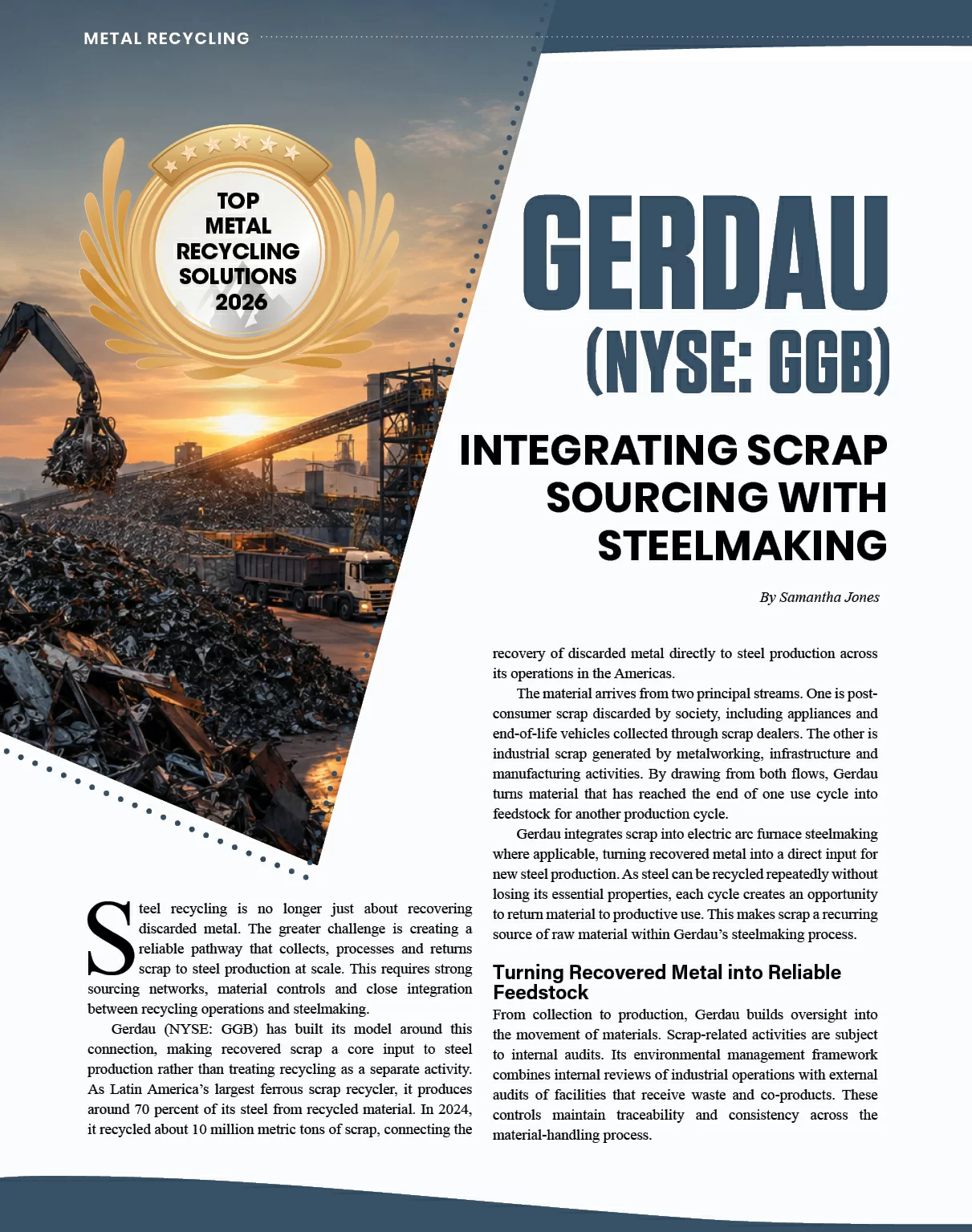
Gerdau [NYSE: GGB] has built its model around this connection, making recovered scrap a core input to steel production rather than treating recycling as a separate activity. As Latin America’s largest ferrous scrap recycler, it produces around 70 percent of its steel from recycled material. In 2024, it recycled about 10 million metric tons of scrap, connecting the recovery of discarded metal directly to steel production across its operations in the Americas.
The material arrives from two principal streams. One is post-consumer scrap discarded by society, including appliances and end-of-life vehicles collected through scrap dealers. The other is industrial scrap generated by metalworking, infrastructure and manufacturing activities. By drawing from both flows, Gerdau turns material that has reached the end of one use cycle into feedstock for another production cycle.
Gerdau integrates scrap into electric arc furnace steelmaking where applicable, turning recovered metal into a direct input for new steel production. As steel can be recycled repeatedly without losing its essential properties, each cycle creates an opportunity to return material to productive use. This makes scrap a recurring source of raw material within Gerdau’s steelmaking process.
Turning Recovered Metal into Reliable Feedstock
From collection to production, Gerdau builds oversight into the movement of materials. Scrap-related activities are subject to internal audits. Its environmental management framework combines internal reviews of industrial operations with external audits of facilities that receive waste and co-products. These controls maintain traceability and consistency across the material-handling process.
Processing is another part of that conversion. Gerdau’s metals recycling activities include purchasing, sorting, processing, preparing and packaging ferrous and non-ferrous scrap. Material ranges from industrial scrap and prepared grades to oversized feedstock and end-of-life vehicles. The work between receipt and reuse is important because discarded metal has to be separated and prepared into forms suitable for handling, commercial movement and eventual use as raw material in steel production.
Scrap is not simply collected and resold without context. Gerdau’s recycling operations are organized around preparing recovered metal for productive use, while its steelmaking footprint provides a destination for significant volumes of ferrous material. This creates a model in which sourcing, processing and consumption can operate as connected stages rather than disconnected transactions.
Building Reliability into the Scrap Chain
Gerdau’s supply network depends on people and businesses that collect, aggregate and move discarded steel. It describes scrap dealers, small businesses and cooperatives as important participants in that chain, alongside larger companies looking for greater transparency in the destination of their material. Long-term relationships with these groups expand the channels through which recoverable metal can return to production while supporting continuity of supply for steelmaking.
A related effort in Colombia focused on strengthening participants further upstream in the collection chain. Gerdau’s Gerir e Reciclar initiative provided training and certification through Universidad Central, a private university in Bogotá, to 225 recyclers belonging to 16 associations. The program was designed to improve conditions around scrap-chain activities and help recyclers strengthen their businesses. This shows that its sourcing approach includes the development of the human network that makes material recovery possible.
Making Circularity Visible in Practice
Gerdau’s 2024 partnership with Senai-SP, a technical and industrial training institution, offers a compact example of a closed material loop. Steel supplied through Comercial Gerdau, its official commercial and distribution business, was used in practical classes. The ferrous scrap generated during those activities was collected and returned to Gerdau’s mills as raw material. Around 700 metric tons of ferrous scrap were recycled through the partnership in 2024, turning routine workshop remnants into feedstock for a new steel production cycle.
In Peru, Siderperu’s Fuego por Juego, an initiative that transforms surrendered or seized firearms into steel products for public use, provides another route from obsolete metal to a new use. Since the program began, 110,000 firearms, equivalent to about 109 metric tons of steel, have been transformed into material used for public playgrounds. Nearly 29,000 firearms were repurposed in 2024, demonstrating how Gerdau can connect collection, transformation and a clearly identifiable second life for recovered steel.
Extending the Value of Recovered Material
The resource impact of scrap is measurable. For every ton of scrap used, Gerdau avoids the consumption of 1.4 tons of iron ore, 740 kilograms of coal and 120 kilograms of limestone, along with 1.5 tons of carbon dioxide emissions. These figures illustrate how each recovered ton can replace a defined amount of virgin inputs in steelmaking, making scrap quality and reliable sourcing critical to the process.
Gerdau also applies circular-economy thinking to materials generated during steel production. Its technological routes enable co-products to be returned to its mills or used in other applications as alternatives to non-renewable raw materials. Examples include steel aggregate and mill scale, with 84 percent of co-products reused. This extends material recovery beyond incoming scrap while reducing the volume sent to landfill or long-term disposal.
Taken together, the approach is defined by more than the volume of metal collected. Gerdau continues to connect household and industrial scrap sources to audited management, preparation, mill consumption and documented reuse pathways, while maintaining relationships with the people who feed that system. Its recognition as the Top Metal Recycling Solution for 2026 reflects the combination of scale, material control and integration with steelmaking that makes recycling a repeatable production capability rather than a stand-alone environmental program.
Company
Gerdau [NYSE: GGB]
Management
Gustavo Werneck da Cunha, CEO
Description
Gerdau is a steel producer and Latin America’s largest ferrous scrap recycler, transforming household and industrial scrap into new steel. Its recycling model integrates sourcing, processing and steelmaking to supply steel products for construction and manufacturing markets across the Americas.