
Metals And Mining Review


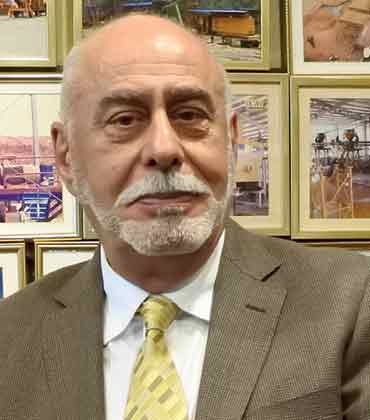 Dr. Fillip Sharifi, CEO
That is the problem DOVE Equipment & Machinery has built its approach around solving. Customers often arrive seeking a machine or the lowest price without understanding what their deposit requires. DOVE, therefore, first educates them, establishes that there is no single solution for every deposit, then determines what the material demands. Rather than starting with a machine, it starts with the deposit, analyzes its characteristics and engineers a processing system around what needs to be recovered.
“It’s not about how many tons soil you wash in alluvial, it’s about how many percent gold you recover,” says Dr. Fillip Sharifi, CEO.
That changes how DOVE believes equipment should be evaluated. A lowerpriced plant can become more expensive if poor recovery leaves substantial deposit’s value behind. The relevant calculation is recoverable gold, not equipment cost.
That philosophy reflects Sharifi’s own experience. Before entering mining, he spent 10 years in the U.S. defense industry and has since led DOVE for nearly four decades while mining across countries. DOVE also operates its own mining company and concessions, transferring field knowledge directly into equipment engineering and manufacturing.
That connection extends to DOVE’s in-house laboratory. The company educates clients on testing representative samples through fire assay and XRF. Where suitable laboratory services are unavailable, customers can send samples to DOVE for analysis and system design suited to the specific ore.
A Pakistan project shows why that analysis matters. DOVE’s testing identified heavy iron concentrations and revealed that much of the gold was locked within the iron. The finding changed the plant design completely. Magnetite, hematite and pyrite have different magnetic properties and require different recovery approaches.
The same recovery focus shapes DOVE’s technology. Its automatic Centrifuge Concentrator recovers gold down to 40 microns. Another proprietary concentrator targets fine gold where budgets are tighter, allowing plants to use different concentrators for coarse and fine particles. For small-scale miners, DOVE offers fully mobile plants on full-size trailers that can be installed in approximately one week to 10 days. The systems are also designed so that operators do not need extensive technical expertise because material is fed into the plant and recovery proceeds automatically.
DOVE has also engineered security into recovery process. Its systems automatically transfer recovered production into a locked vault at defined intervals before it moves to the gold room for weighing, cleaning and further processing. Its plants recycle process water, while a water-treatment module developed within DOVE’s broader group cleans the water before it returns to the concentrators, helping prevent dirty water from affecting recovery. DOVE is also licensed as a green company by the Ministry of Industry and its products are designed without the use of chemicals.
DOVE applies the same problemsolving mindset to mining environments. Conventional river operations pump material from a dredge to a stationary shore plant, limiting the dredge’s range. DOVE’s RIVERMINER® integrates a powerful dredge with a floating processing plant. The dredge can operate 1,000 to 2,000 meters from the plant, pumping material directly into it for immediate processing. The floating plant can move with the operation, has its own control room and high-recovery design.
-
It's not about how many tons soil you wash in alluvial, it's about how many percent gold you recover.
DOVE applies the same problemsolving mindset to mining environments. Conventional river operations pump material from a dredge to a stationary shore plant, limiting the dredge’s range. DOVE’s RIVERMINER® integrates a powerful dredge with a floating processing plant. The dredge can operate 1,000 to 2,000 meters from the plant, pumping material directly into it for immediate processing. The floating plant can move with the operation, has its own control room and high-recovery design.
The principle extends to deposits containing both gold and diamonds. DOVE designs separate recovery paths so the characteristics of one mineral do not compromise recovery of the other. Although alluvial mining is central to this profile, DOVE also produces complete hard-rock processing plants in mobile, portable and stationary configurations, as well as dry processing plants.
The economics of recovery also shape DOVE’s financing plans. DOVE Finance is discussing lease financing with financial organizations to help miners access appropriate processing technology rather than defaulting to cheaper equipment that may compromise recovery.
For DOVE, mining is a scientific process, not a race to move the most material. Understand the deposit, identify the recovery challenge and engineer the processing system accordingly. That principle connects the company’s field experience and technology to one goal: helping miners decide based on recovered value rather than equipment price.
Choosing a Gold Processing Plant Around the Deposit
Alluvial gold projects can lose money before equipment breaks down. The risk begins when a plant is selected before the deposit is understood. Particle size, mineral association, clay content and water conditions can change what a wash plant must do, yet purchasing discussions can still center on throughput and purchase price. A machine may move large volumes without recovering enough gold to justify the capital. For executives approving equipment, the useful question is not simply how much material a plant can process, but how its recovery system fits the actual deposit.
Deposit characterization matters because placer material rarely behaves as a uniform feed. Assay results establish grade, but plant selection also depends on how gold is distributed through the material and what other minerals enter the processing circuit. Sampling and mineralogical work should therefore shape classification and concentration before equipment is specified. Variability across benches or river stretches also matters because a circuit tuned to one sample can underperform as the feed changes. A supplier that begins with machine models rather than the ore shifts geological uncertainty onto the mine owner, who may discover the mismatch only after commissioning.
Fine-gold recovery deserves separate attention. Simple gravity layouts can perform very differently across particle sizes, so buyers should examine how the plant handles coarse fractions and smaller particles rather than accept a single recovery figure. Concentrators also need to be evaluated as part of the full circuit, not as isolated machines. Field conditions matter. Test data should identify the particle-size range behind the claim and the conditions under which it was achieved. Recirculated water carrying clay or suspended solids can alter separation performance, making water handling part of process design rather than a utility decision.
Site constraints can change the purchasing decision sharply. Remote startups may benefit from mobile plants that arrive largely assembled and reduce construction work. River projects introduce mobility and dredging requirements that fixed land-based layouts may not accommodate well. Water availability can favor closed-loop recycling, provided returned water is suitable for concentration stages. Production security deserves attention where recovered gold passes through several hands before it reaches the gold room. None of these issues is prominent on a quotation sheet, yet each can determine whether the plant fits the mine after delivery.
Pre-shipment engineering can expose the difference between a configured plant and a catalog sale. A credible manufacturer should translate sample data into a specific processing route and explain how coarse and fine fractions are handled. It should also show how the configuration responds to water limits and deployment constraints. Capital comparison belongs on recovered production, not purchase price alone. A lower purchase price carries little meaning if the circuit leaves saleable gold in the tailings.
This deposit-led approach is central to DOVE Equipment & Machinery's offering for alluvial gold projects in Asia. Its in-house ore testing and plant design process enables DOVE Equipment & Machinery to match the processing line to the deposit rather than start with a standard wash plant. Its range includes mobile and portable plants, while RiverMiner combines dredging with floating processing for river deposits. DOVE also addresses coarse and fine gold recovery through dedicated concentration. Its plant designs can incorporate recycled-water use and production security. For buyers comparing equipment on recovered value rather than sticker price, the difference is where DOVE starts: with the deposit.
...Read more
Company
DOVE Equipment & Machinery Co., Ltd.
Management
Dr. Fillip Sharifi, CEO
Description
DOVE Equipment & Machinery designs and manufactures mining and mineral-processing equipment and complete processing plants for alluvial and hard-rock applications. Its approach combines client education, ore analysis, mining experience, and application-specific engineering to develop recovery-focused solutions, including mobile, portable, stationary, and river-based processing systems.
