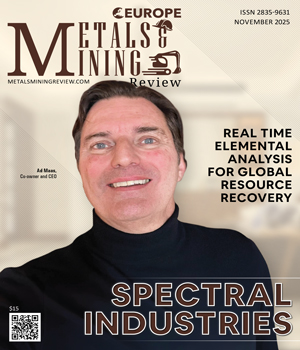

Metals And Mining Review


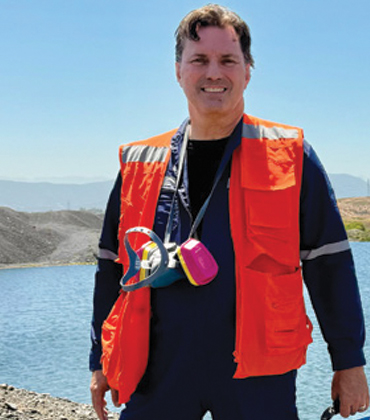 Ad Maas, Co-owner and CEO
What began as space science is now the backbone of industrial chemical analysis.
Spectral re-engineered Laser-Induced Breakdown Spectroscopy (LIBS) into systems that withstand industrial reality. The technology fires a laser pulse to create a microplasma, then analyses the unique spectral signature of its emitted light as an elemental fingerprint. This approach has transformed operations across resource-intensive industries. Mining companies identify ore composition at the point of extraction. Recycling facilities sort materials by chemical makeup in real-time. Metal producers maintain quality control throughout their processes, ensuring specifications are met without production delays.
The instruments are rugged enough for harsh environments, fast enough for conveyor belts and reliable enough to replace centralised lab testing. For operators, this means immediate, on-site chemical data, eliminating delays and blind spots while enabling value recovery from challenging resources.
“Combining science with application enabled the leap from Martian soil to industrial floors,” says Ad Maas, co-owner and CEO. “Our systems are precise in theory and effective in practice, turning elemental insight into operational intelligence that changes how resources are measured, sorted and reused.”
The Calibre Behind the Calibration
The key lies in the calibre and cohesion of Spectral’s team, which is anchored in an ethos of continuous problem-solving and applied learning. Precision science gains value only when it endures the demands of real operations. That philosophy shapes the company’s systems and culture. Over the past decade, the team has grown steadily to include 20 physicists, engineers, geologists and data analysts, with no single departure.
Each member brings more than academic expertise. Mining specialists contribute firsthand knowledge of extraction challenges, while engineers and data scientists translate those realities into robust sensing solutions. This blend ensures clients gain a practical tool tailored to their material flows. It seamlessly integrates with supervisory control and data acquisition (SCADA) systems and plant control environments. Every installation comes with calibration models developed specifically for the customer’s ore or scrap stream, ensuring quantitative and actionable results from day one.
Learning does not stop at delivery. The team continually refines models in dialogue with operators, evolving their systems as resource conditions and production demands shift. This adaptability reflects a mindset where technology is never static; always tuned to real-world use.
“Our customers often tell us the difference is the Spectral team,” says Maas. “Most suppliers avoid the messy, complex applications where conditions change constantly. That’s exactly where we thrive.”
A true breakthrough was not proving that LIBS worked on Earth but redesigning it to deliver what conventional methods could not. Unlike X-ray fluorescence (XRF), which struggles with lighter elements, LIBS measures the periodic table at up to 1000 readings per second. This provides operators with faster, broader and more precise insight into their resources.
-
Combining science with application enabled the leap from Martian soil to industrial floors. Our systems are precise in theory and effective in practice, turning elemental insight into operational intelligence that changes how resources are measured, sorted and reused.
But performance means nothing without durability. Spectral engineered its instruments to operate in environments where dust, vibration, heat and cold are daily realities. Proprietary dust-repulsion technology keeps optical windows clean. Shock-resistant housings protect sensors. Climate controls maintain accuracy in extreme conditions. The result is a system that operates reliably with minimal maintenance, resulting in reduced downtime and lower costs. Remote capabilities extend this resilience, enabling safe measurement in proximity to furnaces, waste sites and hazardous environments.
These capabilities come together in three platforms designed around industrial workflows. BeltPulse provides real-time visibility into conveyor flows, enabling plants to avoid wasted energy and chemicals. CorePulse is an OEM sensor designed for integrators and system designers. It can be utilised in sorters, core scanners and autonomous rovers, enabling customers to transform their instruments into systems that provide immediate, data-driven insights. LabPulse delivers rapid laboratory measurements directly on site, eliminating the need for sample preparation. Each platform turns LIBS analysis into a practical tool embedded in daily operations.
When standard solutions aren’t enough, Spectral partners with mining and recycling clients to co-develop custom sensors. From feasibility studies to full-scale deployment, each system is designed to match operational conditions and scale with future demand. This ensures customers receive technology built specifically for their environment rather than a one-size-fits-all product.
This precision creates a ripple effect for sustainability. Reconciling input ore with the mining plan enables concentrators and operations leaders to predict more accurately and stabilise their chemical and water consumption. High-value materials are recovered with greater predictability and lower cost, breaking down the silos of information between mine planning and mineral processing systems. For clients, this translates into higher yield, lower emissions and more efficient resource use.
Spectral’s systems integrate directly into plant control platforms, where real-time chemical data stabilises feed quality, guides blending and informs strategic decisions. The company continues to work with its clients to realise the vision of fully automated plants, where LIBS drives data-driven decision-making to inform and, where appropriate, adjust processes in real-time, reducing reliance on human intervention.
Proving Value in the Field
Spectral’s LIBS systems prove their value in operations worldwide. The technology works in the lab and directly on the conveyor belt at an Australian lithium mine. Real-time grade measurements flow into the control room, where operators consistently optimise output toward the 5 to 5.5 percent lithium concentration target.
A different challenge emerged in Scandinavia, ‘measuring while drilling.’ The breakthrough occurred at a copper-zinc mine, where Spectral’s system provided elemental depth profiles down to 25 meters in real-time, without requiring physical samples. Cuttings moving through a tube at more than 100 km/h were analysed on the spot, producing reliable data on iron, copper, zinc and magnesium. This translates into faster operating decisions and reduced reliance on lab assays, even in high-speed drilling conditions.
South American copper operations tell a similar story. Across Chile, LIBS systems provide consistent copper grade measurements, enabling tighter process control and improved efficiency where margins are narrow and accuracy is essential. The technology works equally well at major industrial sites and smaller family operations.
Spectral has also partnered in European research initiatives focused on the circular economy, extending LIBS applications from raw ore to secondary metals and recycling streams. These collaborations continue to refine the technology and expand its reach across industries. Spectral has raised €2.5 millon, co-led by VCC and The Nest Group. This support demonstrates the value that Spectral has and positions it as a leading provider of LIBS technology to the mining and metals market.
“We will make LIBS the next standard chemical analysis tool for mining and recycling,” says Maas. “It’s already replacing older nuclear and X-ray-based systems at lower operational cost.”
Spectral has established the continuity and credibility to demonstrate that space-grade precision can transform how industries measure, sort and reuse the materials that sustain the world.
Company
Spectral Industries
Management
Ad Maas, Co-owner and CEO
Description
Spectral Industries delivers space-grade Laser-Induced Breakdown Spectroscopy (LIBS) for mining and recycling. Its systems provide instant elemental analysis directly on conveyors, drilling cores and processing lines, replacing slow lab assays with real-time insight. Rugged, adaptable and precise, Spectral empowers operators to optimise yield, reduce waste and advance sustainability across the resource chain.