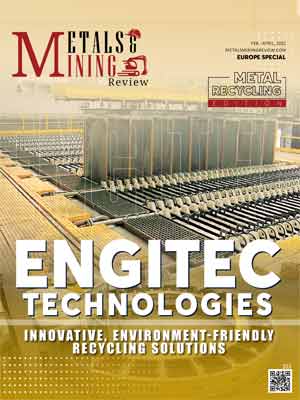
Metals And Mining Review

Engitec headquarters includes Research and Development facilities with fully equipped analysis laboratories and dedicated pilot plant operations for the internal development of innovative technologies for recovering aluminium, lead, copper, and zinc from primary and secondary sources, including scrap, slags, dust, and ore concentrates. All these processes fully comply with the most stringent environmental regulations worldwide. Due to these strict quality control measures, Engitec’s know-how and expertise have been developed, tested and improved through the design and construction of plants in over 40 countries in the five continents. The company’s interactions and subsequent success stories with clients are a testament to this concrete ideology of providing only excellent services.
Cape Gate
To give some context to the first case study, the Ezinex process is a technology that has anticipated the urgent demand for environmental protection and conservation of the planet’s resources for years. Engitec sensed this need many years ago when its R&D laboratories began searching for a new hydrometallurgical and electrochemical process to recover zinc and iron still present in significant quantities in the dust captured by the filters that clean the gaseous emissions of steel mills before their emission into the atmosphere. This dust is classified as dangerous substances and is currently dumped in special authorised sites or heat-treated in other furnaces, with the known consequences of serious environmental impact.

After years of tests, failures and successes, the Ezinex process for the cold hydrometallurgical and electrochemical treatment of Steel Plant Dust, called EAFD, came to life in the pilot plant built in the Engitec laboratory and then in a semi-industrial plant built at an Italian steel mill. But the ingenuity of an engineering and research company like Engitec was not enough to achieve the industrial development of such a revolutionary technology. It needed the vision and courage of a steel industry entrepreneur who wanted to invest in it.
Engitec found this entrepreneur in the South African company Cape Gate Pty LTD, located in the Gauteng region, which understood Ezinex technology’s benefits to its steel plant in terms of environmental benefits by drastically reducing waste and effective implementation of circular economy in its production cycle.

The Ezinex process is a technology to process the EAF flue dust and to recover as high-quality metal the zinc therein contained (the EZINEX technology). Cape Gate is interested in this technology as it will reduce its flue dust disposal/storage and cost, and, at the same time, it produces metallic zinc for their galvanised product. Before engaging itself for the order of an industrial plant, Cape Gate wanted to be sure about the effectiveness of the Ezinex process and the quality of the obtained zinc. At the same time, it was also Engitec’s desire to have the first industrial Ezinex plant in operation and to have a closed cooperation with C.G. to optimise the Ezinex process. Therefore Engitec built and operated at own cost. A demonstration plant installed in the Cape Gate facility with the agreement that, in case of positive results, it would order to Engitec the industrial plant. The demo plant successfully reached the desired performances with satisfaction of Cape Gate. The Covid-19 pandemic however put the project on hold until the overall conditions allow to resume it in profitable and safe way.
-
‘Inspiring Innovation’ is the key company mission of Engitec, which is pursued daily by developing recycling technologies to enable efficiency and environmental compliance.
Liaoning Teli Environmental Protection Technology
Yetanother success story is centred on the Chinese company Liaoning Teli Environmental Protection Technology–when it decided to invest in a new battery recycling plant. Since the company needed to respect the new and very strict environment protection rules and emission limits, they decided to look for the best available technology and chose Engitec as the supplier to meet and guarantee the new emission limits. In particular, the new SO2 and NOx emission limits were lower than the current European ones. Teli’s goal was also to minimise the production of slags from the rotary furnace when smelting the lead products. Engitec’s reputation as an experienced and reliable supplier allowed the company to secure the contract. The plant Engitec made for Teli comprises: battery breaker and components separation, lead products desulphurisation, Super Desulphurization, Crystallisation of the (detergent grade) sodium sulphate obtained as a by-product, automatic rotary furnaces charging system, a lead foundry with two rotary furnaces, lead refinery, and lead ingots casting line with ingots stacking robot.

The new environment protection rules for lead producers imposed in China and the new plant Engitec made for Teli set a new standard for environmentally safe recycling of lead-acid batteries. The desulphurisation of the lead products (PbSO4 and sulphuric acid of the batteries) allows the sulphur removal before smelting, thus avoiding the creation of SO2 and, consequently, avoiding the need for a subsequent unit to remove it from the fumes. The process’s control and chemical reactions allow the Engitec plant to limit the residual sulphur in the lead products to a level that allows meet the imposed SO2 emission limits during smelting. Teli now has one of China’s most advanced lead battery recycling plants.
Company
Engitec Technologies c
Management
Thomas Kaspar, General Manager
Description
Offering technologies and plants for recycling of lead-acid batteries and non-ferrous metals, reducing the impact on the environment of waste generated from recycling them by reusing it